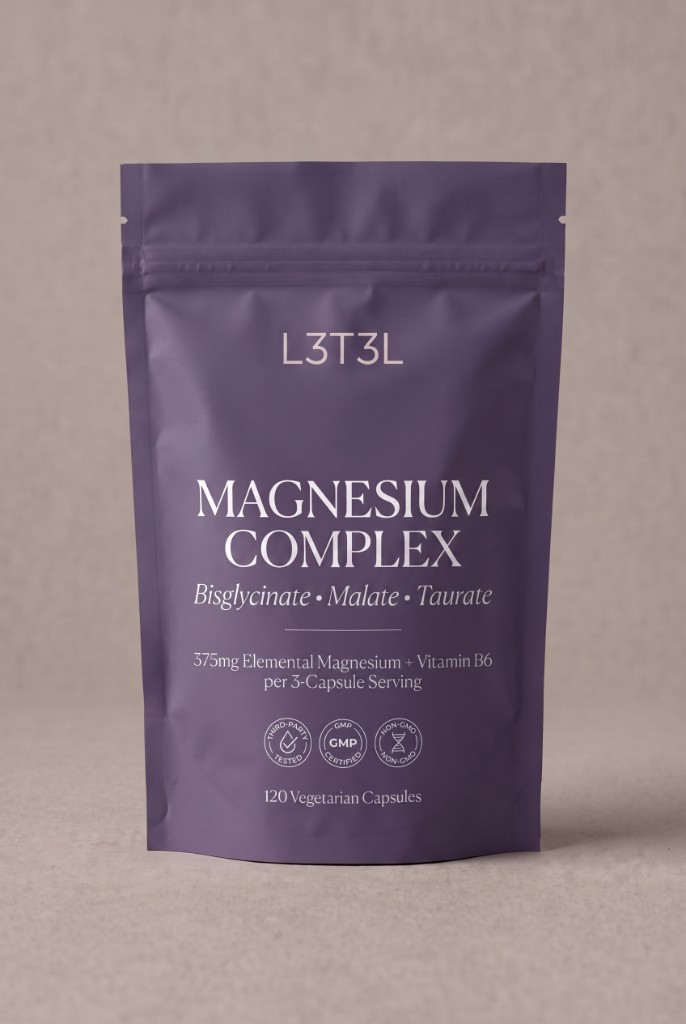
Bisglycinate · Malate · Taurate, with vitamin B6
Most labels quote the weight of the compound, not the mineral — so a "1,500mg" bottle hands you about 150mg of actual magnesium. L3T3L Complex states the number that matters: 375mg of elemental magnesium per serving, from three absorbable forms.
The part nobody tells you
"1,500mg Magnesium Bisglycinate" is the weight of the whole compound — mineral plus carrier. Bisglycinate is only around a tenth magnesium by weight, so that headline dose is really about 150mg. The figure that counts is elemental magnesium, and once you compare on that basis, most products are handing you a quarter of a serving.
Sound familiar?
That's the most common story we hear — and it's rarely because magnesium doesn't work for you. It's because so little of it arrived, in a single form, doing a single job.
An estimated half of adults fall short of the magnesium they need from food alone. A 100mg top-up won't close that gap. 375mg across three forms, with the cofactor that helps it into your cells, is a different proposition entirely.
What's inside
Magnesium behaves differently depending on what it's bound to — the carrier molecule matters almost as much as the mineral. Rather than pick one form and hope it covers everything, we use three, and add the cofactor that helps magnesium get where it's going.
i.
Magnesium bound to two glycine molecules. Glycine is a calming amino acid in its own right, which is why bisglycinate is the form associated with winding down and easier sleep — and why it's gentle enough for stomachs that can't tolerate citrate.
ii.
Bound to malic acid, a molecule your cells already use in the cycle that produces ATP. It's the form people reach for when the problem is daytime fatigue and muscles that stay sore longer than they should.
iii.
Bound to taurine, an amino acid concentrated in heart and nervous tissue. Taurate is the least common of the three and the most frequently left out — it's the reason this is a complex rather than another glycinate with a new label.
iv.
Magnesium has to cross into the cell to do anything at all, and vitamin B6 supports that transport. The two are so often studied as a pair that leaving B6 out is a false economy — so we didn't.
Third-party tested every batch for identity, potency and heavy metals, in a GMP-certified facility. Non-GMO and vegetarian. Every certificate of analysis is published against the batch number printed on your pouch.
Side by side
When a serving delivers a quarter of the magnesium you need, you either under-dose quietly or buy multiples to compensate. Priced per day that actually reaches 375mg, the maths flips.
| L3T3L Complex | Single-form bisglycinate | Magnesium oxide | |
|---|---|---|---|
| Forms | Bisglycinate + malate + taurate | Bisglycinate only | Mineral salt |
| Elemental magnesium per serving | 375mg, stated on the front | ~100–200mg, usually buried | High on paper, ~4% absorbed |
| Share of the 375mg NRV | 100% | 27–53% | Nominal only |
| Cofactor for cellular uptake | Vitamin B6 included | Rarely | None |
| Gentle on digestion | Yes — all three amino-acid bound | Usually | Common laxative effect |
| Batch-level third-party testing | Every batch, published | Sometimes, rarely published | Rarely |
| Cost per full-NRV day | $1.20 | Multiplies — 2–4× the servings | Cheap label, poor value |
375mg is the EU Nutrient Reference Value for magnesium; US RDAs range from 310–420mg depending on age and sex. Comparison figures reflect commonly sold products — individual formulations vary, and absorption estimates for oral magnesium forms differ between studies.
Your daily ritual
Take all three with water in the evening if sleep is what you're after — bisglycinate and taurate do their best work while you wind down. If daytime energy is the goal, split them: two in the morning with food, one before bed. Either way, consistency is what moves the needle.
From people who'd almost given up on magnesium
I'd tried three brands over two years and honestly thought magnesium was a scam. Turns out I'd been taking about 100mg of it. Two weeks on an actual full serving and my 3am wake-ups are mostly gone.
— Placeholder review · Sarah M., 34I expected the sleep part. What I didn't expect was the 3pm slump easing off, which I'm putting down to the malate. I take two in the morning and one at night now. No stomach issues at all, which citrate never managed.
— Placeholder review · Daniel R., 47I went and checked the elemental number on the three bottles in my cupboard and not one of them came close. Same price bracket, roughly three times the actual magnesium, and taurate which I couldn't find anywhere else. Easy decision.
— Placeholder review · Priya K., 29
Bisglycinate · Malate · Taurate with vitamin B6 — 120 vegetarian capsules
Take the full pouch. If you don't feel the difference, one email within 60 days gets you a complete refund — keep whatever's left.
Questions, answered honestly
No — it's considerably more. That 1,500mg is the weight of the entire compound, mineral plus carrier. Magnesium bisglycinate is only around 10% magnesium by weight, so a 1,500mg dose is roughly 150mg of actual magnesium. Our 375mg is the elemental figure: the magnesium itself, after the carrier is subtracted. Compare elemental to elemental and the gap is wide.
Because the carrier molecule does its own work once absorbed. Glycine is calming, malic acid feeds the cycle your cells use to make energy, and taurine concentrates in heart and nervous tissue. A single-form product quietly asks you to pick which of those benefits you want. A complex doesn't make you choose.
Two likely reasons. First, dose — if you were on a typical two-capsule bisglycinate, you were probably getting around 100mg of elemental magnesium against a 375mg reference value. Second, form: one compound covers one set of jobs. This is a full serving across three forms, with B6 to support getting it into the cell rather than straight back out.
Yes, split it if you like. All three capsules in the evening suits people whose main goal is sleep and wind-down. If daytime fatigue is the bigger issue, take two in the morning with food and one before bed so the malate is working while you are. Take them with food if your stomach is at all sensitive.
Magnesium is only useful once it's inside the cell, and vitamin B6 supports that transport — the two are so frequently studied together that omitting B6 is a false economy. It's included as a supporting cofactor dose, not a megadose.
All three forms here are amino-acid bound rather than mineral salts, so they don't draw water into the bowel the way oxide and citrate do. There's no magnesium oxide in the formula at all — that's the usual culprit behind the laxative effect people associate with magnesium.
Every batch is tested by an independent lab for identity, potency, and contaminants including heavy metals. The batch number on your pouch matches a published certificate of analysis you can read before you open it.
Magnesium is widely used alongside common supplements, but it can interact with certain medications, including some antibiotics and blood-pressure treatments, and long-term high-dose vitamin B6 has its own considerations. If you take prescription medication, are pregnant, or are managing a health condition, check with your doctor or pharmacist first — we'd rather you ask than guess.
Then it costs you nothing. Take the pouch as directed; if you don't feel a genuine difference, email us within 60 days for a complete refund. No return shipping, no forms, no hoops.
Join the list for your code, plus short, useful notes on sleep, stress, and getting minerals right — no noise, unsubscribe anytime.
Check your inbox — your code is on its way.
Wire this form to your email platform (Klaviyo, Mailchimp, ConvertKit) before launch.